These are photos taken at the Chinese Garden where there were lots of Shandong rocks.
The Hibiscus and Punica gratum shrubs were not bushy or were suffering somewhat from nutrient deficiency symptoms. We shall see, in time to come, how the plants are reacting to the recent fertilizing with both straight and compound fertilizers.
I am getting worried for the hospital. Almost everywhere I looked, the plants appeared to be rather yellowish and are suffering from acute nitrogen nutrient deficiency. With such severe symptoms, it would likely take some time to correct them.
Darling, I am sorry I have to let you down and let you go. I noticed that you have been unhappy but you are not the problem. You have been excellent and have given me lots of excitement and joy when we were together. The problem lies with me. I just don't think I have the house and the means to provide for you anymore. I realized this recently and think I have found you a better place to be.
Just like the many others before you, you are the old one and I have found another new one who is better, who can probably give me more happiness than you. Let me introduce you Strophanthus preussii to Ipomoea tricolor from Mexico, who has taken over your place in my plant container. Before you were Quisqualis indica, Mirabilis jalapa, Lonicera, and you were all my favourites at some point. Sadly, all of you were very demanding in your nutrient needs and my miserable plant container could not sustain you in a healthy condition. You were often showing symptoms of nutrient deficiency that I could not correct, so I have to transplant you somewhere where I think you will have all the space and nutrients necessary to grow optimally, just like the one I grew in HortPark that climbed at least 6 m up the Parinari corymbosa (synonym: Maranthes corymbosa; Family: Chrysobalanaceae) tree.
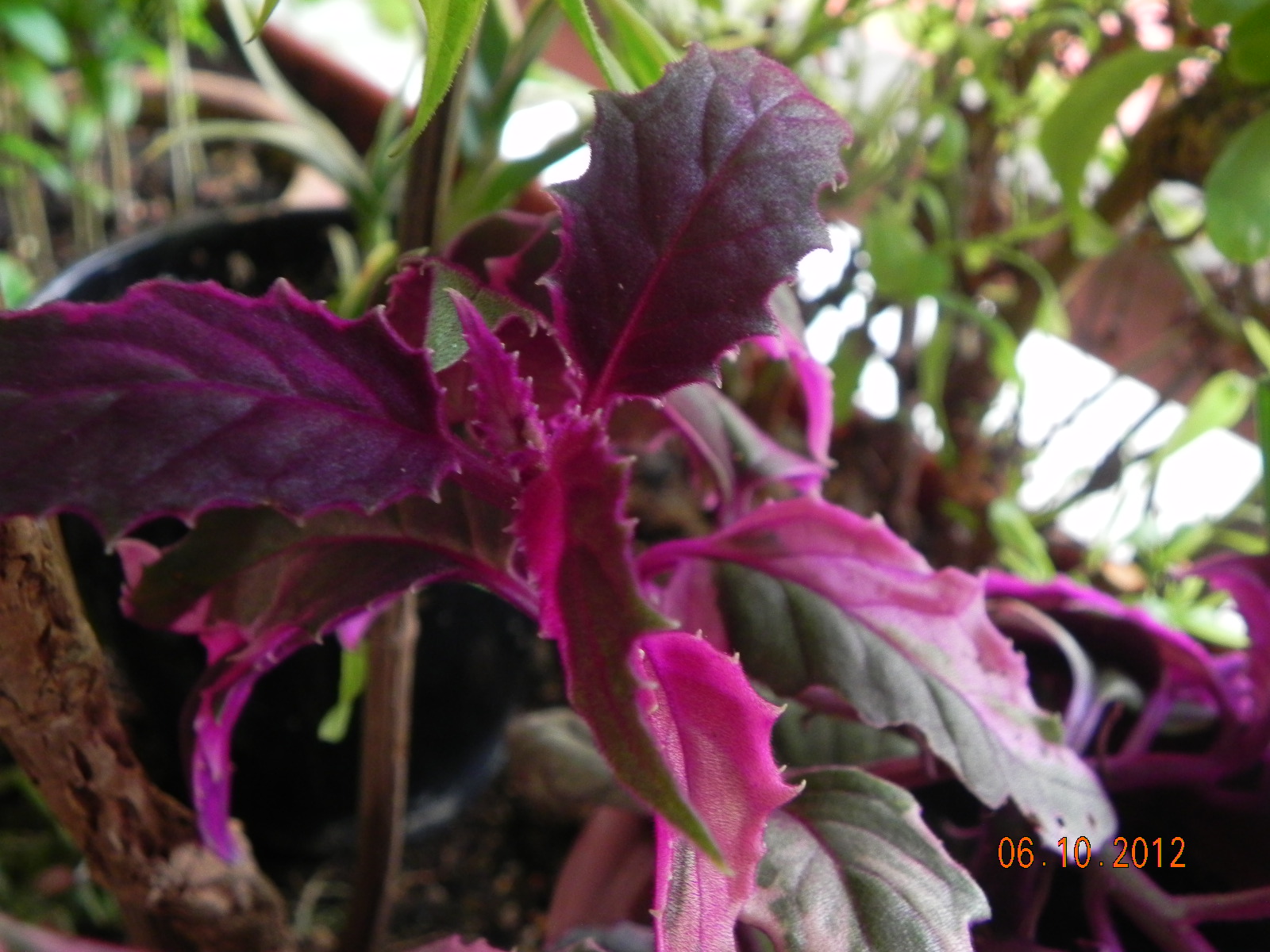
On a separate note, let me introduce another new member of my plant collection the variegated Gynura aurantiaca (common name: Purple Passion Plant, Purple Velvet Plant; Family: Asteraceae/Compositae) from Java. This is not the first time I have this plant and I simply love this plant for its velvety purple colour and texture and serrated leaves. It's amazingly beautiful and I definitely hope it survives this time.
Unlike the two earlier posts on HortPark, this one focuses more on pests and diseases and nutrient deficiency symptoms.
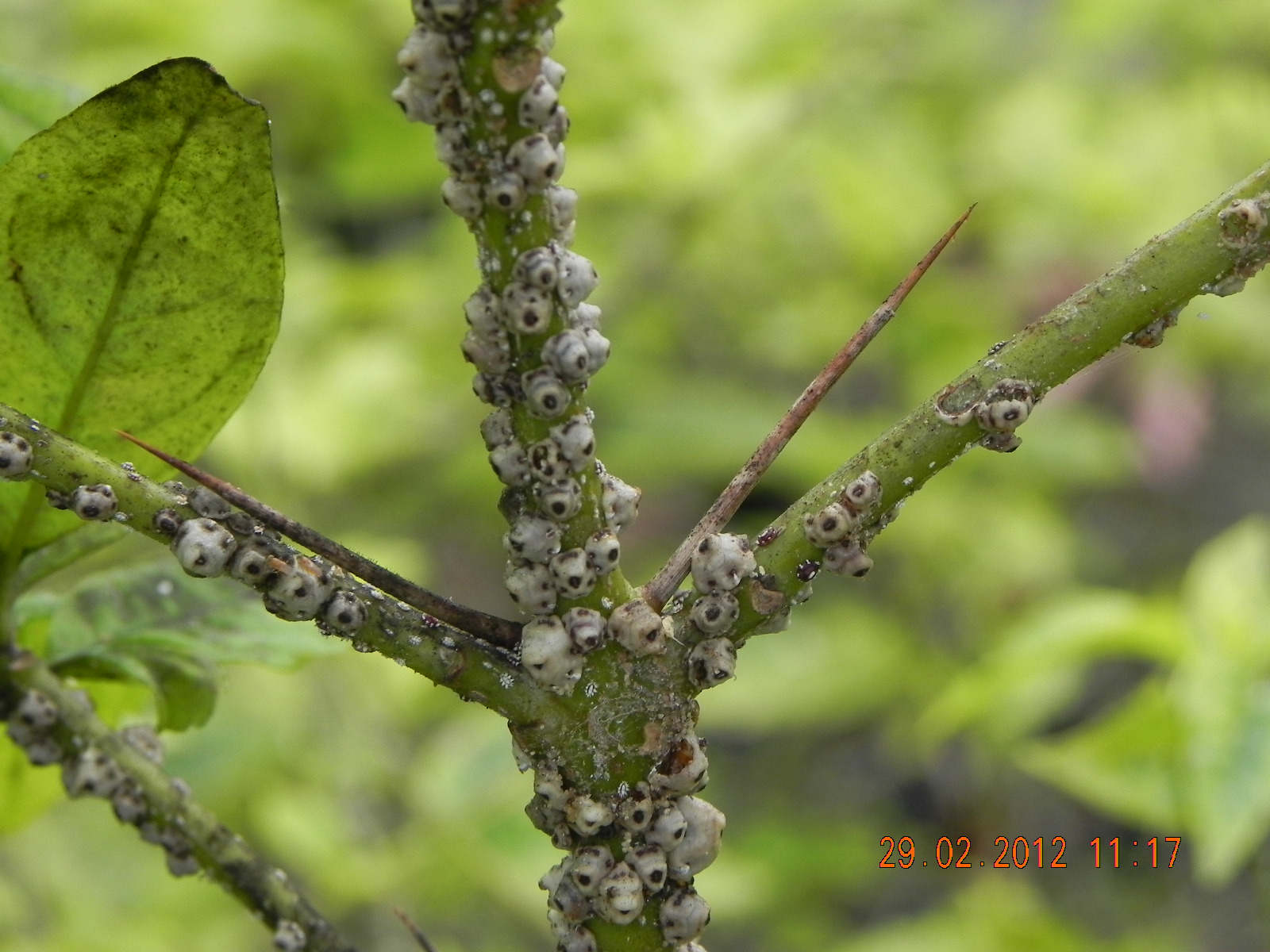
There is a wide range of scale insects shown here. Some even look like barnacles on the stems and branches of the plants. The blackish soot-like layer on the leaves is the sooty mould, brought about by the scale insects. Usually, sucking insects like scales, aphids, mealy bugs secrete a honey dew-like substance that attracts ants. The ants harvest the substance and in turn farm these insects and protect them from other predators.
There was also a grasshopper, spotted on the leaf of a Canna plant, which typically chews the leaves causing extensive damages.
The variegated and non-variegated Manihot esculenta (common name: Tapioca) is also a nest bed of mealy bugs.
The leaves of the Diospyros malabarica tree were also badly damaged by the Bagworms.
The 3 stages of the Ladybird were also captured by the camera. Who would have thought that their larval stages look entirely different from the winged insect?
The reddish edge of the leaves of this particular Tristaniopsis whiteana tree was showing symptoms of possibly phosphorus deficiency.
Hispid beetles were found on the badly damaged fronds of the Coconut Palm.
Finally, this alien like moth caterpillar, which I captured before, was busy eating the leaves of the Ardisia elliptica.
Like humans suffering from weariness, these trees, palms, shrubs and climbers planted in planter boxes are starting to exhibit signs and symptoms of chronic nutrient deficiency.
Unless they are regularly fed with a combination of organic fertilizers in the long term and compound fertilizers with trace elements in the short term, the problem will not go away so easily.
I wasn't able to take close-up photos of the plants from where I was because my camera was out of battery then. Well, let's see how the situation will be the next time I come here.
I know my blog and posts are boring to most people but it wouldn't stop me from posting because this has become like a photographic diary to me. I could never maintain a diary for more than 3 months but I have this blog for more than a year now and I still have not entertained the idea of shutting it down. For this, I am proud of myself.
So anyway, these are some interesting plants at the Singapore Botanic Gardens. The first is the strongly variegated Sanchezia nobilis, which I find astonishingly and amazingly beautiful since the first time I saw it at the former Alexandra Hospital.
The second is the native Peristrophe roxburghiana (common name: Magenta Plant; Family: Acanthaceae) with small purple two-lobed flowers. Frankly, I am not particularly wowed by this herb.
Then there are these very cute Plectranthus scutellarioides 'Trailing Salamandar' (common name: Coleus) and the uncommon and straggly Plumbago indica. I posted on the Ardisia gigantifolia on 7 Aug 10 and looked how big they are now. However, I hate it that they are suffering from severe nutrient deficiency symptoms.