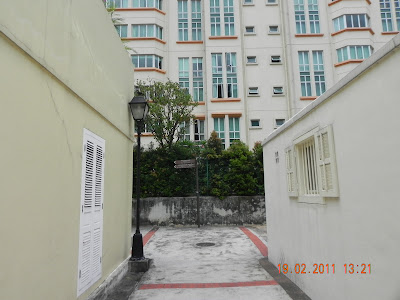
Continuing from the previous post, this is the view of the city skyscrapers beyond the low-rise shophouses.
My favourite Muntingia calabura is still standing there. I remember plucking and eating the red berries every time when I was there. This time round, there wasn't a single red berry. They must have been eaten by the birds. Unlike the stands of Muntingia which I planted in HortPark, this particular one is so healthy and the fruits are not diseased at all.
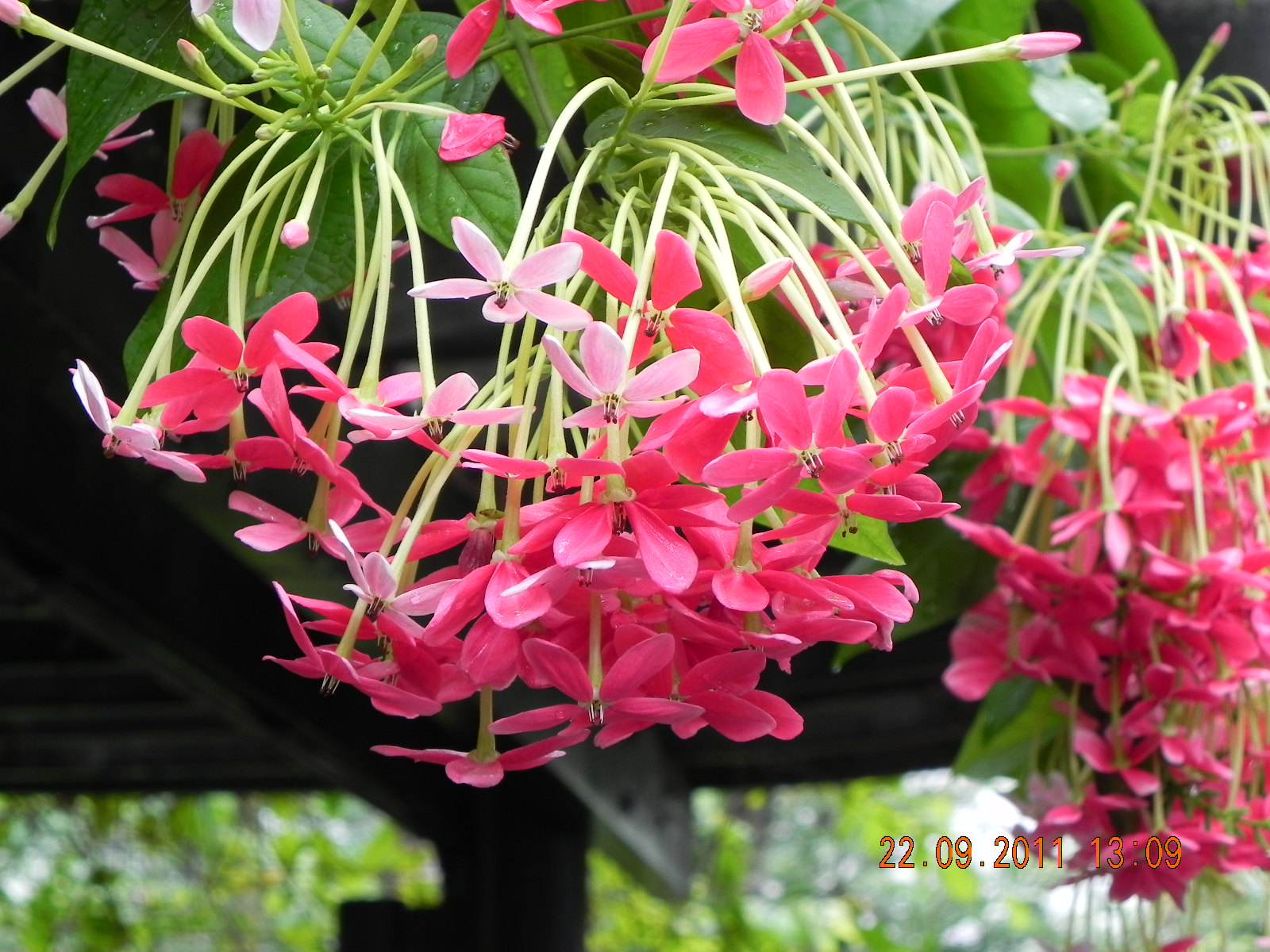
By the way, the pendulous umbels of the Quisqualis indica never fails to take my breath away. If the one planted by me flowers like this, I would never have uprooted it. As I walked down the steps along the timber walkway to the next nearby park, I turned around and took a quick last glance because I have no idea when I would be here again.
Showing posts with label ann siang hill. Show all posts
14 October 2011
13 October 2011
ANN SIANG HILL PARK PART 1
I was at Amoy Street Food Centre for lunch and took the opportunity to take some photos of this Ann Siang Hill Park, which I was involved in developing. Looking at the park, I could spot areas of improvement, which I prefer not to refer to as mistakes. I have gained more experience over the years and would have done things slightly differently.
This was also the park where I first tried out the Syzygium buxifolium, which was previously mistaken as Myrtus communis. I am glad that the plant is still around. The Clerodendrum inerme is one of the less attractive member of the genus but it is an uncommon plant in a garden.
The spiral staircase is one of the highlights of this small pocket park. But before I climb up the stairs to the cantilevered upper deck, I walked along the footpath to the foot of the structure. The area under the deck was enclosed by a grid fence and the Quisqualis indica was planted within a verge less than 30 cm wide. On hindsight, we shouldn't have constructed such a narrow strip of planting area and I should not have chosen this climber too. The climber had few flowers and was displaying nutrient deficiency symptoms. Looking at it, I felt the grid has a huge potential for a beautiful, sustainable greenwall project.
Till today, the very uncommon Litchi chinensis is still suffering from water stress, presumably because it is on a steep slope with half the root system buried under deep soil and the other half of the roots drastically severed.
Up on the timber deck, the wooden swing was removed and the Quisqualis was growing all over the trellis, the severely nutrient deficient Bauhinia kockiana grown within the narrow and shallow planter and the beautiful Cinnamomum iners tree.
Labels:
amoy street,
ann siang hill,
cinnamomum,
clerodendrum,
litchi,
myrtus,
quisqualis,
syzygium buxifolium
01 March 2011
ANN SIANG HILL PARK
One of the historical wells was preserved and highlighted as one of the interesting features of the pocket park. If I remember correctly, the depth of water in the well was around
4 m deep.
A spiral staircase leads visitors to the upper timber, where there used to be a wooden swing. At that vantage point, one could see the big trees within the park, including 2 large Lychee (scientific name: Nephelium litch; synonym: Litchi chinensis; Family: Sapindaceae) trees but they were gone from the site.
There was also a flowering Syzygium with beautiful blooms of white flowers. The Muntingia calabura (common name: Strawberry Tree, Jam Tree; Family: Elaeocarpaceae) at the corner of the upper deck before the turn is still there and the fresh red cherry-like fruits still tasted as sweet as I remember. It is also a favourite with some of the birds. Because of my love for this tree, I planted so many of them at HortPark's Irrigation Pond but they never gave me a single fruit for eating because of disease problems.
Surprisingly, the Rondeletia leucophylla that was introduced back then is still at the site, which is testament of how hardy the shrub is.
2 links on the interesting trees are attached here:
Labels:
ann siang hill,
lychee,
muntingia,
rondeletia,
syzygium
Subscribe to:
Posts (Atom)