Showing posts with label epiphyte. Show all posts

12 May 2014

CYMBIDIUM FINLAYSONIA

I was bowled over by these flowers. They may be petite but they look so delicately pretty. It is an amazing epiphyte with such understated beauty.


05 March 2012

HOYA

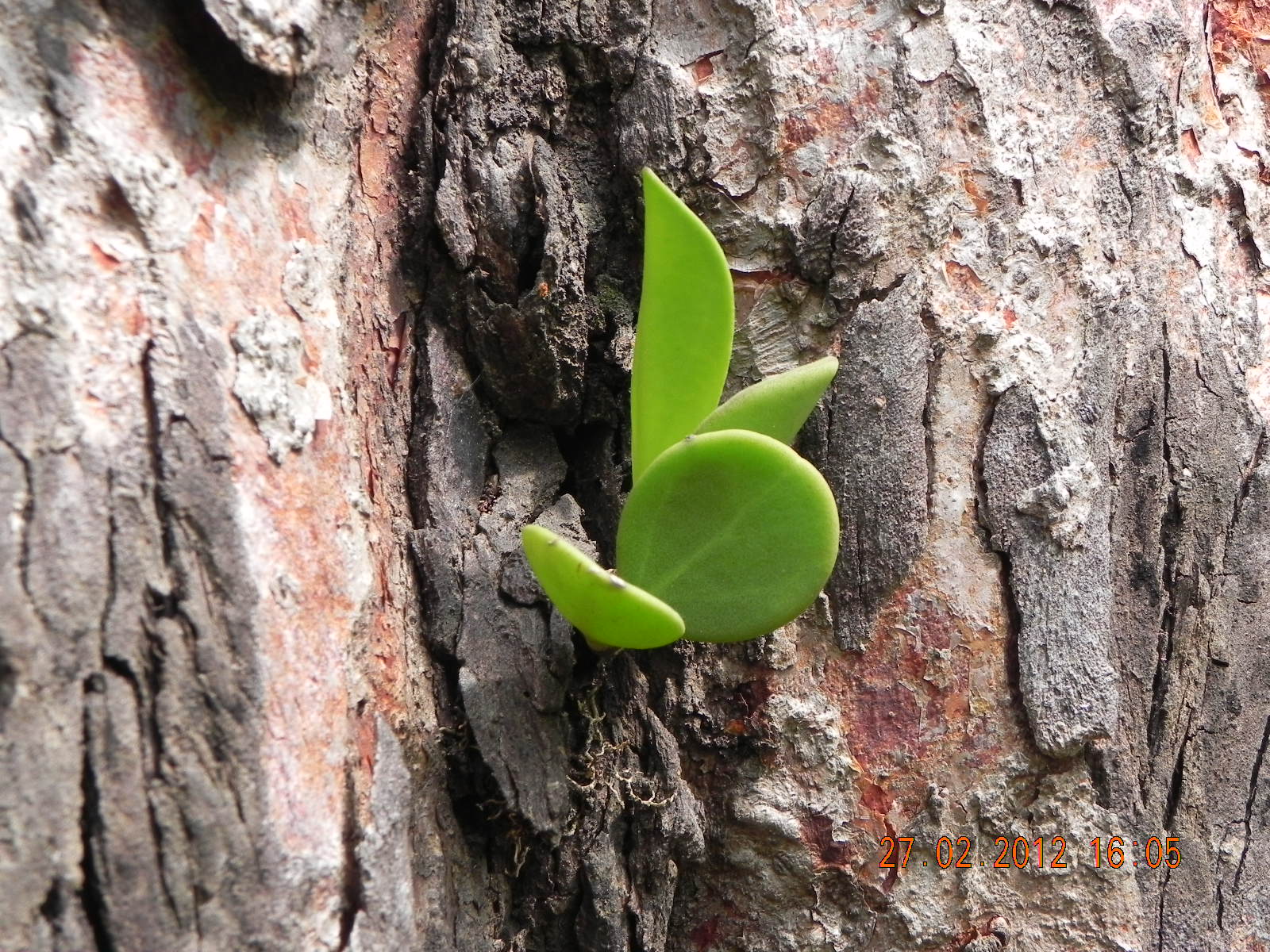
This seems like a very familiar epiphyte growing in a crevice on the tree trunk and I suspect it is a Hoya although I am not entirely sure of the species. Let us see how it grows.


23 February 2012

SARACA & EPIPHYTES

 Today's weather - sunny
These Saraca trees planted around 2005 at this down ramp from ECP to Beach Road are so big and beautiful now. I am glad we made the right choice.


On the other side of the road, the epiphytes on the Rain Tree are also colonizing the tree forks naturally. I just wished there were more tree branches so the picture looked more complete.


27 January 2012

EPIPHYTES

I attended a talk this afternoon on the subject epiphytes and was inspired to blog about it. The speaker Harry E. Luther, Asst Director (Research) of the Gardens by the Bay and author of the book Native Bromeliads of Florida shared with the audience the vast diversity of epiphytes in the tropics. In simple terms, an epiphyte refers to a plant that grows on another plant for physical support, which is in contrast to parasitic plants that grow likewise but rely on their host plants for nutrition. Some examples of epiphytes include many orchids, some ferns, bromeliads, gesneriads, Hoya and so on.


I am amazed by his wealth of knowledge and experience and was in awe of the beautiful photos he took over the years and showed on the screen for our viewing. It came as no surprise that he featured a lot of bromeliads, known as broms in short, especially since he is a well-known authority on this plant group in the botanical community. Midway through the talk, I realized I didn't take any notes and decided to record some pointers for my own noting. They are briefly as follows:


  • Hemi-epiphyte - I mentioned this term before in some of my posts and refers to plants e.g. strangling figs, that begin its life as an epiphyte by growing on another plant such as a tree and which eventually sends its roots down to the ground and grow into a self-supporting plant on its own.
  • Tank bromeliad - This refers to the group of bromeliads e.g. Neoregelia species, with broad leaf bases that overlap each other in a rosette to form a central reservoir, sometimes referred to as an urn or a cup, that functions as a receptacle that collects water, leaf-litter, decaying animals etc. These broms are often excellent biodiversity multipliers.
  • Bodiversity multiplier - This is the first time I heard this term. The tank broms are regarded as such because their central reservoir of water is an ecosystem on its own and supports a multitude of living organisms up the food chain and web, from the microscopic bacteria and protozoan to the worms, insects, crustaceans, frogs, birds, snakes and so on.
  • Pteridophyte - This refers to a specific group of vascular plants that do not produce flowers or seeds. These plants are very specialized and reproduce themselves via spores. Ferns and mosses belong to this group. Some common examples of pteridophytic epiphytes include the Bird Nest Fern, Stag Horn Fern.
  • Broms with large inflorescence of warm coloured flowers - The pollinators of these broms with red and orange-coloured flowers are usually small birds e.g. hummingbirds, sunbirds, which are attracted by the showy colours to visit the flowers for their nectar.
  • Aeschynanthus is from the Old World and Columnea is from the New World - I have always wonder how we can distinguish between the two easily and today I was rewarded as an attentive listener! It is the first time that I realized that they come from two different worlds. The latter is bird pollinated and its flowers are two-lipped as in typical hummingbird or sunbird pollinated flowers.
  • Medinilla magnifica - I was reminded of this beautiful epiphyte that is often planted as a ground shrub instead. I first saw photos of it as an epiphyte in the book Tropical Garden Plants and wanted to try planting it on tree forks for years but never got to actually do it. I feel very tempted to try it now.
  • Broms evolution - Broms are finely attuned to its habitat, which strongly influences its morphological evolution into many different forms e.g. narrow leaves, broad leaves.
Photo taken from website http://mounttotumas.com/wordpress/?p=172     

01 March 2011

TELOK AYER PARK - PLATYCERIUM CORONARIUM

I had to split this post from the previous because I do not want to negate its beauty by subsuming it under a generic post on the park. It deserves a post of its own. Planted on a Yellow Flame Tree and located just beside the covered linkway, the Stag's Horn Fern has grown so big now since I planted it.

The infertile basal fronds and fertile dichotomous fronds are beautiful and hidden amongst them were 2 fertile kidney-shaped fronds with masses of sporangia, containing the spores. This is what I call beautiful! When I was snapping photos of the epiphyte, an auntie walked past and was staring at what I was doing before she eventually walked off. She must have wondered what a crazy person I was to take photos of plants on a Saturday afternoon.


14 February 2011

TIONG BAHRU PARK - EPIPHYTES

These Rain Trees in Tiong Bahru Park are covered with an assortment of epiphytes, which refers to non-parasitic plants growing on other plants. The 3 main epiphytes here include the Bird's Nest Fern, Oak Leaf Fern and Philodendron.

A link on the epiphyte is shown below:

11 October 2010

EPIPHYTES WALL

This epiphytes wall was one of my favourite landscape feature when the Singapore Botanic Garden's HQ upgrading was completed.

Planted up with lots of epiphytes, some stowaways and weeds eventually crept in too. Now what is in place is a very natural wall with an assortment of ferns, Anthurium, Nepenthes, Begonia, bromeliads etc, above a pool of water with aquatic plants. It is absolutely gorgeous.