Showing posts with label oxalis. Show all posts

02 September 2011

HOUSE PLANTS

This Brugmansia is one of my last cuttings since I killed the previous one that gave me lots of pure, simple pleasure and happiness when I see its amazing blooms coupled with its strong aromatic fragrance! By the way, out of these 3 recent blooms, 1 opened up torn and distorted. I wonder what happened?


The second series of photos show a watersprout from my Quisqualis indica climber. This shoot was growing so fast but in the wrong direction blocking the pathway and I had no choice except to snip it off before my annoyed neighbours do so. But this is not the purpose for me to post the pruned branch. They say you learn something everyday and that was what happened to me. I learnt that the climber has adaptations that help it to hold on to supporting structures in a bid to climb higher. I just realized that the thorns on the twig are actually the remnant leaf petioles after the leaf drops off. Hmm, how interesting!


Finally, the leaf of the Oxalis triangularis apparently contains some oil that helps it to repel water. Just look at the water droplet on the leaf.


22 March 2011

MUNIA'S PLAYGROUND

My Scaly-Breasted Munia friends were playing a game of hide-and-seek with me in their playground. As I laid hiding behind the tall grasses, they finally came out to eat the seed heads of the Pennisetum alopecuroides and Variegated Panicum maximum. Then the overzealous gardener came forth with the water hose and with his sudden appearance, the timid birds flew away from the spot.

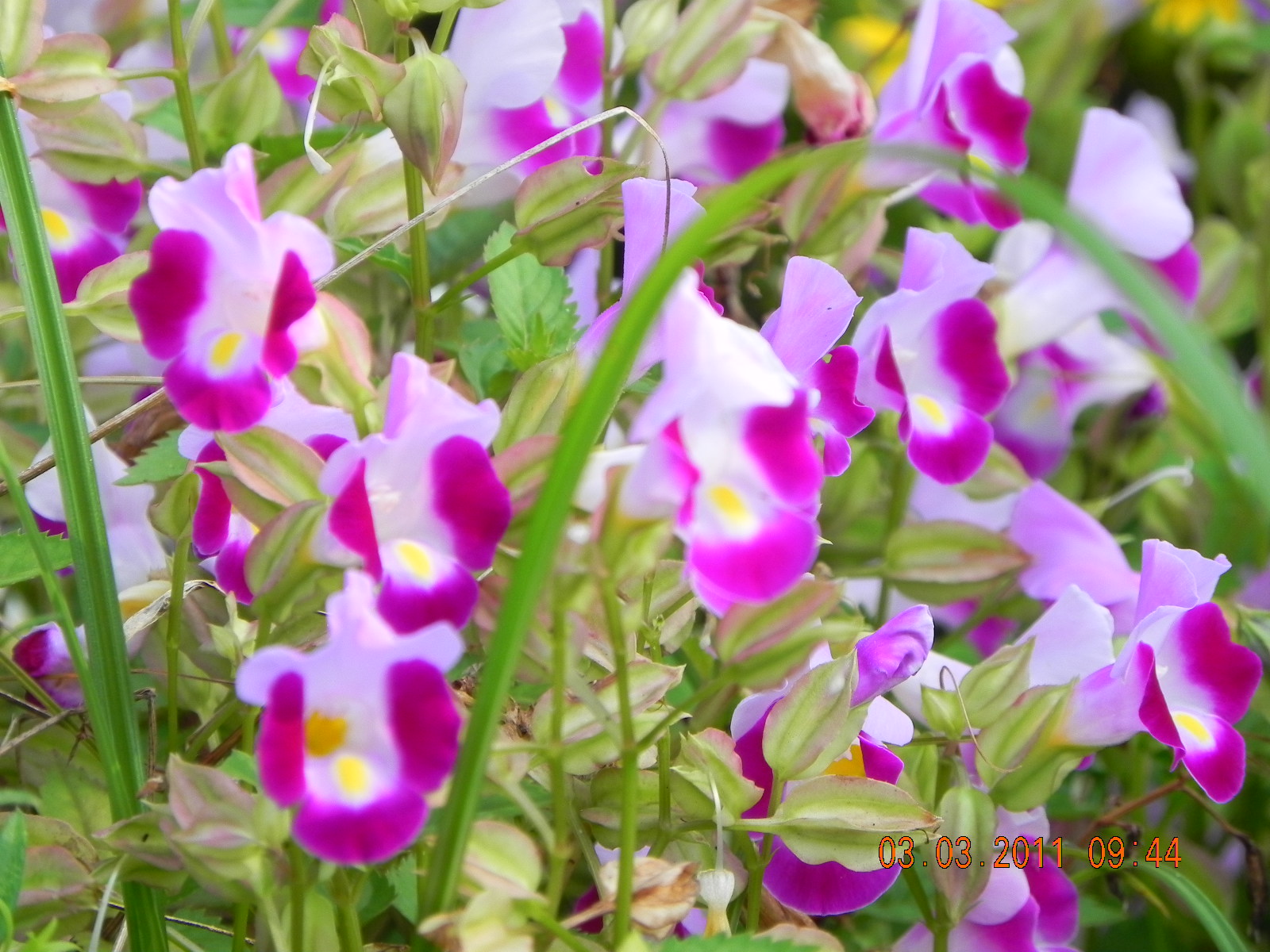
Although the gardener saw me with my camera, he made no apologies and turned on the hose to water the plants. What a letdown. Fortunately, I managed to take some photos of the beautiful bed of Melampodium paludosum (synonym: M. divaricatum; common name: Butter Daisy, Star Daisy, Gold Medallion Flower, African Zinnia; Family: Asteraceae / Compositae), white flower Oxalis and Torenia fournieri (common name: Wishbone Flower, Bluewings Flower, Torenia; Family: Scrophulariaceae) before the water came down on the bed.

Some links on the plants are attached here for reference:


28 February 2011

WHITE

For months now, this landscape reminded me of snow because of the white colour flowers and variegated leaves. Some of these plants were posted by me before and one plant is noticeably missing although it is on the site. The one that is missing in action is the white flower Oxalis. The others are:
  1. Orthosiphon aristatus (variegated)
  2. Clematis aristata
  3. Pennisetum alopecuroides
  4. Panicum maximum (variegated)
  5. Angelonia cultivar
There are several cultivars of Angelonia angustifolia (common name: Summer Snapdragon, Angel Flower; Family: Scrophulariaceae) and this one could be any of the following. Some links are attached below:
  1. http://www.ballhort.com/Landscapers/plant_info.aspx?phid=004904608005863
  2. http://www.ballhort.com/Landscapers/plant_info.aspx?phid=004902212005886
  3. http://www.flowersofindia.net/catalog/slides/White%20Angelonia.html


17 January 2011

AFTER RAIN

This is the area outside the glasshouse. It is planted with an assortment of beautiful plants of varying forms, textures and colours, taken after the rain too.

The plants include the Aster, Tibouchina, white Oxalis, variegated Orthosiphon and Gloriosa. I am not sure if the Oxalis is Oxalis crassipes 'Alba' (Family: Oxalidaceae) or O. tuberosa since I have not done any research on this plant to confirm its identity. A link on this genus is shown here:

11 January 2011

WEEDS

This is a weeds galore. Weeds and more weeds! It is the order of the day.

Like I mentioned before in a previous post, I don't know everything. But the familiar ones include Hemigraphis reptans, Phyllanthus urinaria and Oxalis. The other recognizable ones include a Ficus next to a drain grating. And the trio of small lovely flowers are from the Hemigraphis.

Isn't it simply amazing how some of them can just grow from a minor wedge in the ground and obtain its sustenance from the small gap for survival? They have all such a strong will to live despite all odds. I guess we should all learn from them to survive under dire circumstances.