Showing posts with label chocolate. Show all posts

26 October 2014

CERBERA

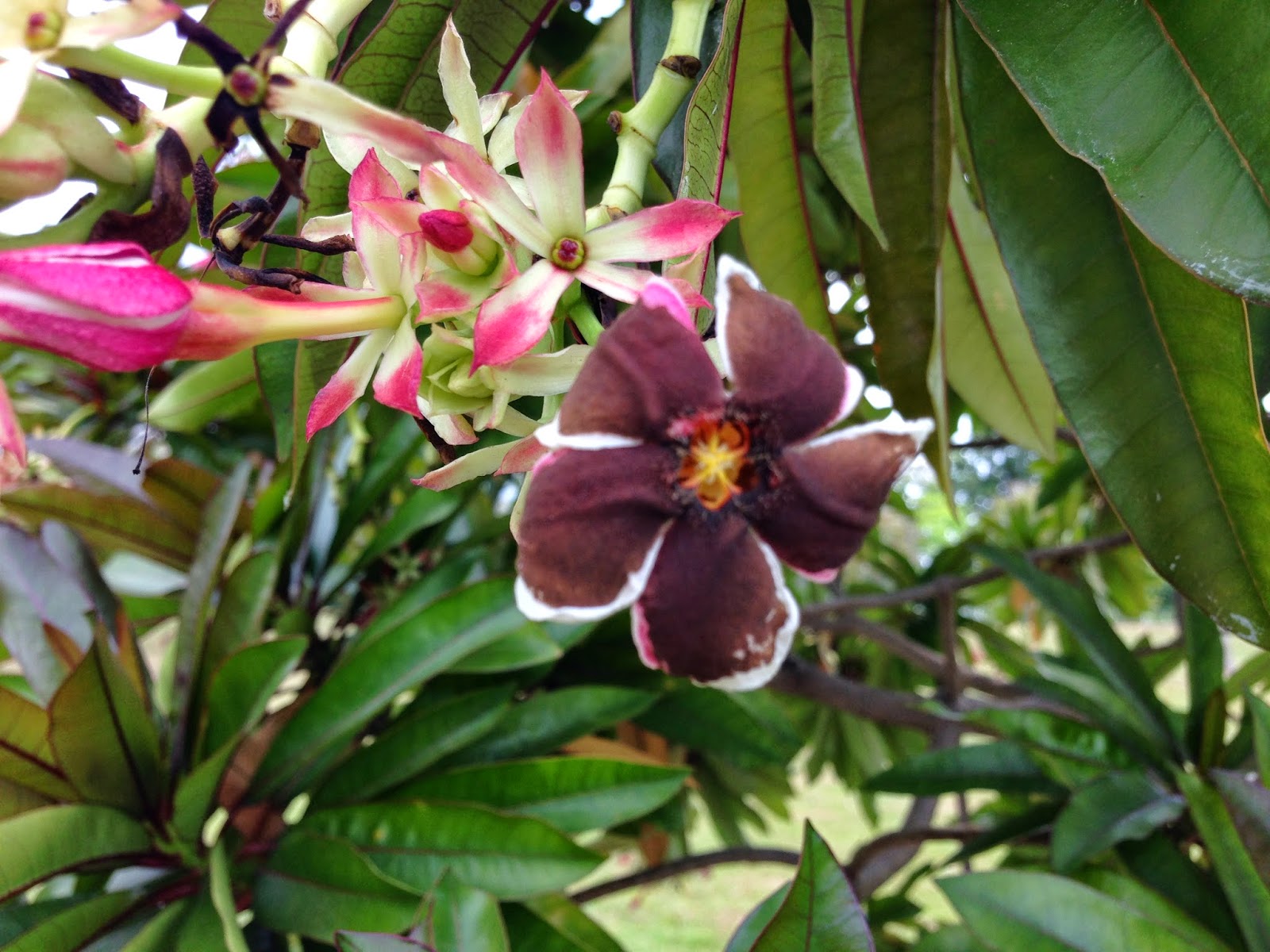
I have seen this red-leaved Cerbera flowered but I have never seen the flowers in this dark chocolate colour before. Do they fade from pink to this, I wonder?


13 February 2014

THEOBROMA CACAO

Yes, this is the tree (Family: Malvaceae) where we get our cocoa for our chocolate.

The ones in Colonial Garden are getting quite established and quite a number of its fruits are produced on the trees.

The developing fruits along its trunk

A ripening or ripened cocoa bean


25 May 2013

PORTLANDIA GRANDIFLORA

I just updated the post in Oct 12 on the identity of this amazing plant. Known as Bell Flower, Glorious Flower of Cuba etc, this small tree up to about 5 m tall was named after the Duchess of Portland and is known to grow well in alkaline soils. The fragrance of the flowers has been described as a warm, creamy chocolate scent. 

15 May 2013

CHOCOLATE PANSY

The Chocolate Pansy is pretty commonly seen throughout the garden.

26 December 2012

CHOCOLATE LIQUEURS

I got these Anthony Berg chocolate liqueurs. Each of these dark chocolate bottles is individually wrapped in foil representative of the liqueur brand's bottle. They look so lovely that I can't bear to eat them.


25 December 2010

CHRISTMAS

This small christmas present was on my desk and the colour reminded me somewhat of this year's colour. Hidden within were just 4 small packs of cookies, chocolates etc. Yummy!

07 September 2010

THEOBROMA CACAO

This is a Cocoa Tree from the Malvaceae Family. It has been growing the commercial plants area for a very long time.

Recently, they were producing attractively coloured new leaf flushes. And the cacao fruits were hanging on the trunk of the tree. These are the fruits where the seeds are used to grind into cocoa powder.

All our chocolate, milo etc are all produced from this powder. This is how important this commercial crop is. A link is attached below:

05 June 2010

BUTTERFLY ENCOUNTERS

I passed by this area last week and the large stands of Caesalpinia pulcherrima (Peacock Flower) attracted quite a number of butterflies there to pick up nectar. This morning, I passed by this area again and the usual butterflies were still there.

Last week, I saw 3 Lime Butterflies, a number of Common Grass Yellows, a few Mottled Emigrants and Chocolate Soldiers. Today I saw only a single Lime Butterfly, the usual abundant Common Grass Yellows, some Mottled Emigrants and at least 3 Chocolate Soldiers. It was interesting to see them circling each other at times, as part of the courtship ritual. Different species were sometimes seen chasing each other, but split when their contact was so close that they probably realised they are of a different species and are hence incompatible for mating.

But I hate to take photos of butterflies in the open because it really tests your patience. Frankly, the Lime Butterfly is one of my favourites and I sometimes see them around my plants at home. However, you can see how my photos turned out when I tried to capture it on my camera last week. How exasperating that can be!

Anyway, luckily this morning, I was able to take a photo of a single Chocolate Soldier that landed on the leaf of a Hymenocallis speciosa (Spiderlily).

So my conclusion to this is plant more Peacock Flowers everywhere because they are a staple source of nectar for quite a number of urban butterflies and they are the very important host plants of some of these butterflies e.g. Common Grass Yellow.


20 December 2009

STROBILANTHES CUSIA

The photos here do not do justice to this interesting plant which can grow to at least 1.5 m. It is best grown as a single specimen plant in a landscape and should be allowed to tower over the lower plants grown with it to best effect.

The green leaves give character to this plant with its prominent veins. The numerous small pinkish flowers hang at different levels giving it an effect of dangling bells.

Another interesting thing is this plant is a host plant to the butterfly Chocolate Pansy.