Showing posts with label purple. Show all posts

07 October 2012

OLD AND NEW

Darling, I am sorry I have to let you down and let you go. I noticed that you have been unhappy but you are not the problem. You have been excellent and have given me lots of excitement and joy when we were together. The problem lies with me. I just don't think I have the house and the means to provide for you anymore. I realized this recently and think I have found you a better place to be.

Just like the many others before you, you are the old one and I have found another new one who is better, who can probably give me more happiness than you. Let me introduce you Strophanthus preussii to Ipomoea tricolor from Mexico, who has taken over your place in my plant container. Before you were Quisqualis indica, Mirabilis jalapa, Lonicera, and you were all my favourites at some point. Sadly, all of you were very demanding in your nutrient needs and my miserable plant container could not sustain you in a healthy condition. You were often showing symptoms of nutrient deficiency that I could not correct, so I have to transplant you somewhere where I think you will have all the space and nutrients necessary to grow optimally, just like the one I grew in HortPark that climbed at least 6 m up the Parinari corymbosa (synonym: Maranthes corymbosa; Family: Chrysobalanaceae) tree.

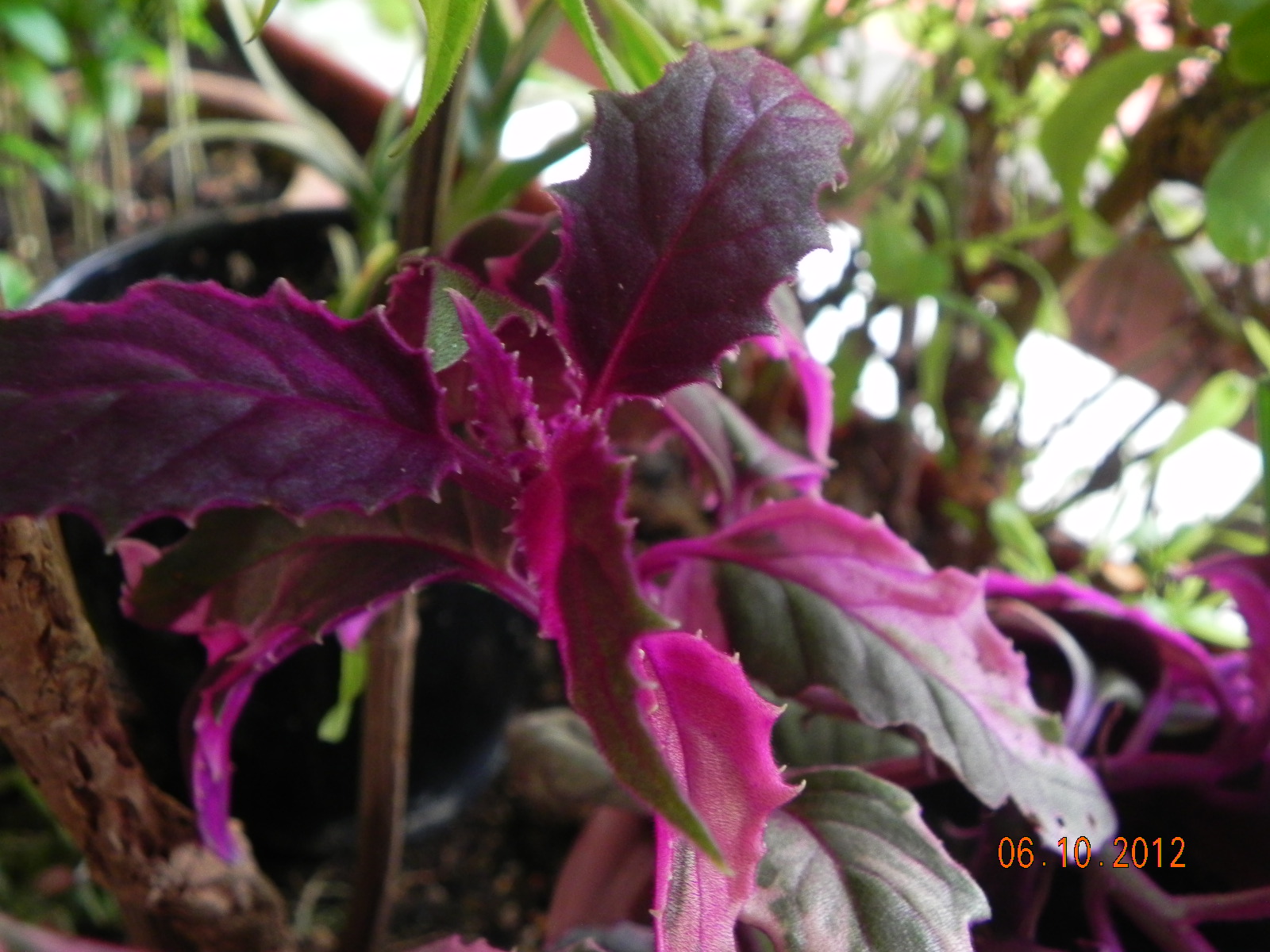
On a separate note, let me introduce another new member of my plant collection the variegated Gynura aurantiaca (common name: Purple Passion Plant, Purple Velvet Plant; Family: Asteraceae/Compositae) from Java. This is not the first time I have this plant and I simply love this plant for its velvety purple colour and texture and serrated leaves. It's amazingly beautiful and I definitely hope it survives this time.


02 May 2011

PURPLE

This is a very beautiful garden despite the size. It does not always look like this but it took shape gradually and I am so proud of the industry partner.


The plant heights, purplish-pink colours and leaf shapes of the Cordyline and Pennisetum contrast so well with and against each other that it looks amazing.

25 December 2010

CHRISTMAS

This small christmas present was on my desk and the colour reminded me somewhat of this year's colour. Hidden within were just 4 small packs of cookies, chocolates etc. Yummy!

23 November 2010

ACANTHACEAE PLANT

I have no idea what is the name of this plant but I do know it is from the Acanthaceae Family with its typical inflorescence made up of overlapping bracts.

What is interesting about this plant is its purplish hairy leaves and inflorescences. But like most members of this Family, the plant is prone to infestation by sucking insects.


02 September 2010

MILLETTIA RETICULATA

After watching 'Desperate Housewives', who could forget or who could not be besotted with the beautiful Wisteria? So when I was told there is an Evergreen Wisteria, I was more than elated. A synonym is Callerya reticulata.

Seeing the actual plant is kind of a disappointment because the tropical version of it was no where close. But I told myself not to impose unreasonable comparisons between the plants. I have to treat this as a plant on its own, with its own merits.

So, I do find this bushy climber interesting and although the flowering is not profuse, the purplish small flowers are rather unusual and pretty in its own way. Pollination of the flowers produces bean-like pods, typical of the Fabaceae (Leguminosae) Family.

The flowers were described as highly fragrant, although I did not detect any smell. A link is provided below for reference:

19 August 2010

MELASTOMA MALABATHRICUM

I posted about this native Straits Rhododendron recently. I also posted about the Clappertonia recently.

Both plants have similar flower and stamen colours. But both are from different families and have different leaves and fruits.

So what is the link here? Am I missing something?


18 August 2010

CLAPPERTONIA FICIFOLIA

I posted about this plant recently too. I think I ended it with saying that there are 2 overlapping whorls of 4 petals where one set is narrow and long and another set is rounded.

Don't the purple flowers and yellow stamens remotely resemble another familiar plant?

When the flower is pollinated, it develops into this red spiky capsule which dries up into a brown colour and which eventually splits into 4 parts to release the ripe seeds. The spikes on the capsule may not be very sharp but it still feels slightly prickly to the hands.