This is supposed to be a white-flower Quisqualis known by the cultivar 'Jessie's Star'.
These yellow-leaved Quisqualis were planted in several areas of the garden but this is the first time that I see it in flower. I went like "holy shit" when I saw it. I don't know if anyone else noticed it.
 |
| Close-up of the flowers |
Darling, I am sorry I have to let you down and let you go. I noticed that you have been unhappy but you are not the problem. You have been excellent and have given me lots of excitement and joy when we were together. The problem lies with me. I just don't think I have the house and the means to provide for you anymore. I realized this recently and think I have found you a better place to be.
Just like the many others before you, you are the old one and I have found another new one who is better, who can probably give me more happiness than you. Let me introduce you Strophanthus preussii to Ipomoea tricolor from Mexico, who has taken over your place in my plant container. Before you were Quisqualis indica, Mirabilis jalapa, Lonicera, and you were all my favourites at some point. Sadly, all of you were very demanding in your nutrient needs and my miserable plant container could not sustain you in a healthy condition. You were often showing symptoms of nutrient deficiency that I could not correct, so I have to transplant you somewhere where I think you will have all the space and nutrients necessary to grow optimally, just like the one I grew in HortPark that climbed at least 6 m up the Parinari corymbosa (synonym: Maranthes corymbosa; Family: Chrysobalanaceae) tree.
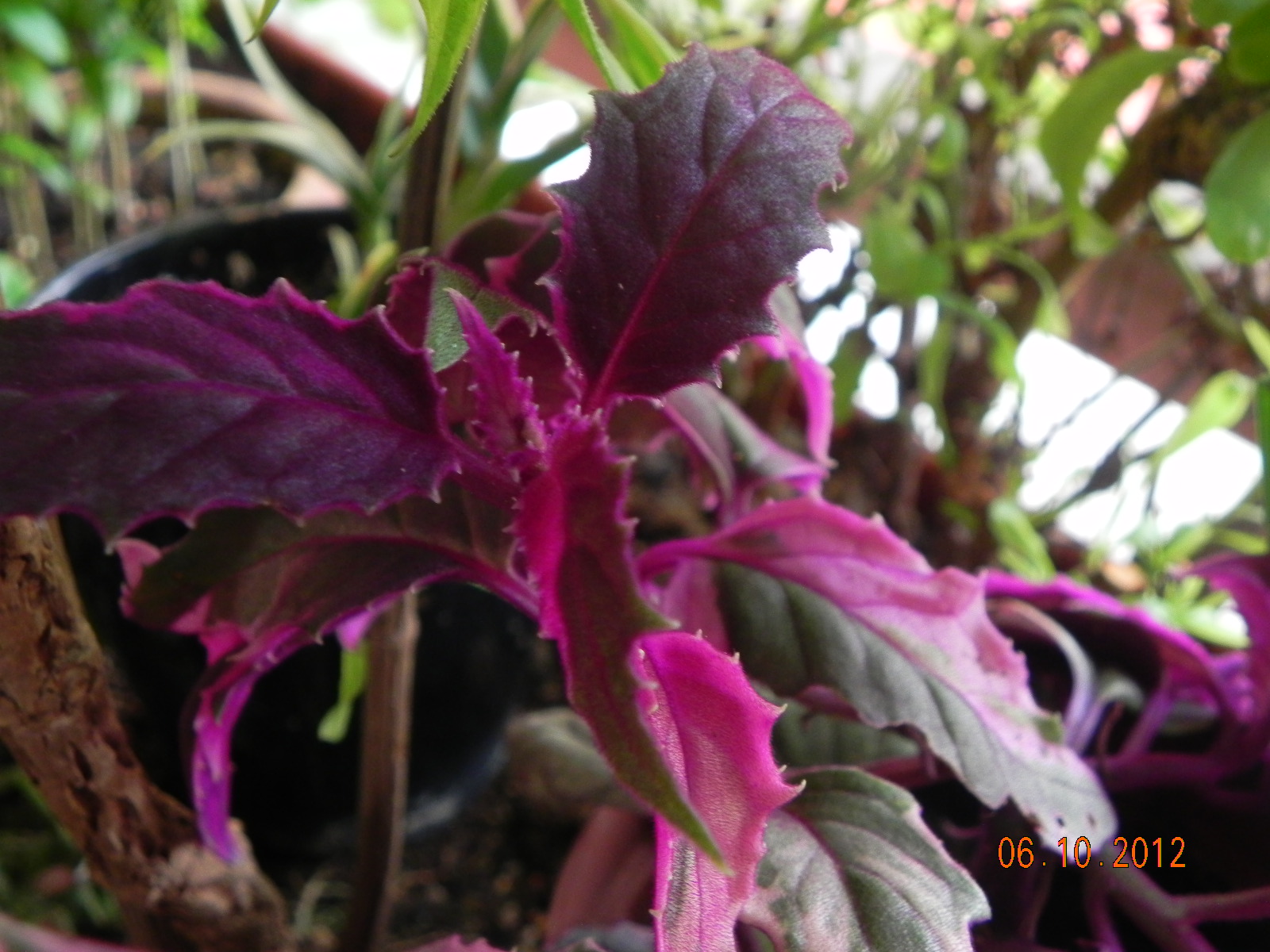
On a separate note, let me introduce another new member of my plant collection the variegated Gynura aurantiaca (common name: Purple Passion Plant, Purple Velvet Plant; Family: Asteraceae/Compositae) from Java. This is not the first time I have this plant and I simply love this plant for its velvety purple colour and texture and serrated leaves. It's amazingly beautiful and I definitely hope it survives this time.
 Today's weather - sunny
These beautiful landscape and plant photos were taken at HortPark recently.
The first few photos taken at the Floral Walk show the very beautiful and unusual ginger Tapeinochilos ananassae (common name: Indonesian Wax Ginger; Family: Costaceae).
The next few photos show one of my favourite tropical plants, the Megaskepasma erythrochlamys (common name: Brazilian Red Cloak; Family: Acanthaceae), that I often use in my landscape projects. I definitely feel it is under-appreciated and underused in landscaping.
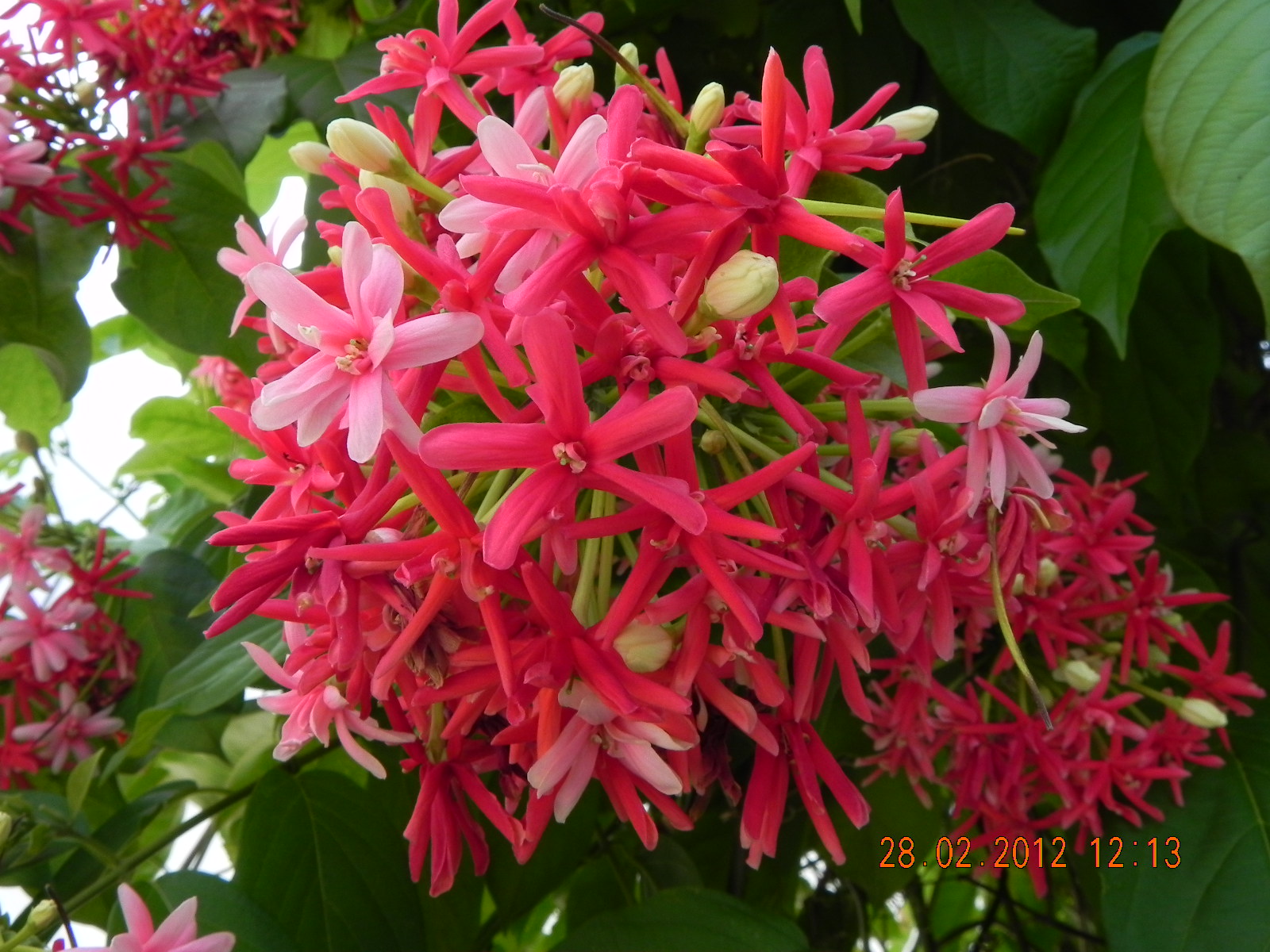
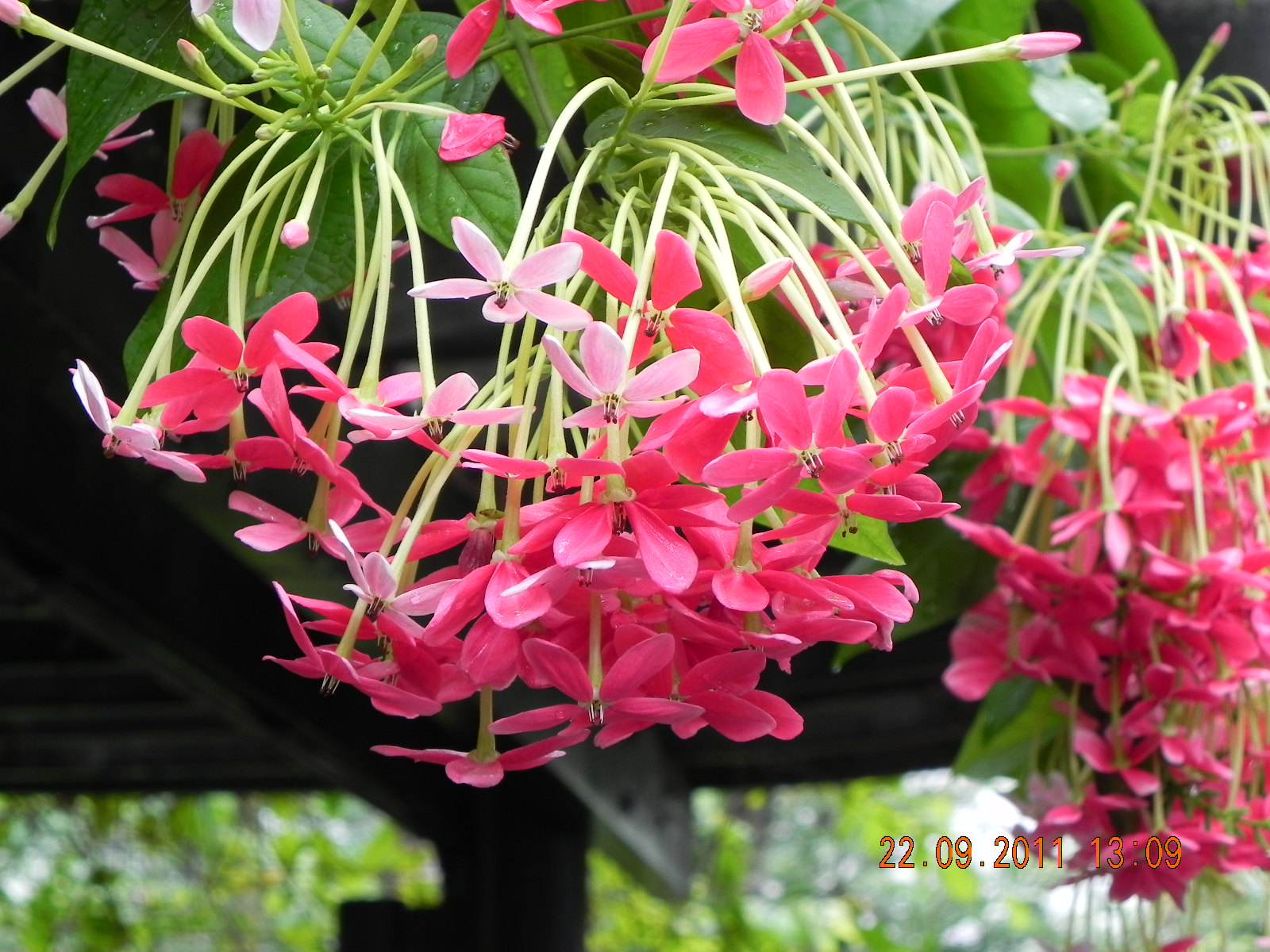
Over at the Prototype Glasshouses, the double petaled Quisqualis indica (common name: Drunken Sailor, Rangoon Creeper, Chinese Honeysuckle, Scarlet Rangoon; Family: Combretaceae) is putting out its best display to maximum effect. Who wouldn't fall in love with such an amazing climber with bunches of pendulous fragrant flowers? I don't need to be a sailor to be bewitched by it.
I also saw this unknown bird on the Ascelpias curassavica (common name: Blood Flower; Family: Apocynaceae) at the Golden Garden. Interestingly, I don't think I have seen this bird before.
Beside this garden were lots of fluttering butterflies hanging around the numerous nectar plants, such as the Leopard butterfly feeding on the nectar of the Lantana camara or Cnidoscolus chayamansa (synonym: C. aconitifolius; common name: Maya Spinach Tree; Family: Euphorbiaceae). It is certainly not surprising, considering that this is the outdoor garden of the Butterfly Garden. I also spotted the skittish Cycad Blue or Plains Cupid (scientific name: Chilades pandava; Lycaenidae) butterfly on the Antigonon leptopus (common name: Honolulu Creeper, Coral Vine, Mexican Creeper; Family: Polygonaceae).
Every time I visit this park, I am always rewarded with something pleasant that brightens up my day if I am patient enough to pay attention to my surroundings.
Continuing from the previous post, this is the view of the city skyscrapers beyond the low-rise shophouses.
My favourite Muntingia calabura is still standing there. I remember plucking and eating the red berries every time when I was there. This time round, there wasn't a single red berry. They must have been eaten by the birds. Unlike the stands of Muntingia which I planted in HortPark, this particular one is so healthy and the fruits are not diseased at all.
By the way, the pendulous umbels of the Quisqualis indica never fails to take my breath away. If the one planted by me flowers like this, I would never have uprooted it. As I walked down the steps along the timber walkway to the next nearby park, I turned around and took a quick last glance because I have no idea when I would be here again.