Showing posts with label fabaceae. Show all posts

05 October 2013

MUCUNA BENNETTII

It has been some time since I last wrote about some uncommon or interesting plants in the Bay South garden.

If one looks at the first photo of the area near the koi pond, it is not surprising to miss an interesting sight that I want to draw attention to.

But if you look closely at one of the trellises that rises from the pond and goes over the footbridge that connects Colonial Garden (Heritage Gardens) and Discover Garden (World of Plants), you will notice a splash of fiery orange against a mass of green leaves. The colour reminds one of the flowers of Spathodea campanulata (Common Name: African Tulip; Family: Bignoniaceae) but a Spathodea it is most certainly not.

If you are able to look at the flowers closely, you will find that it is growing from the tropical woody vine commonly known as the Scarlet Jade Vine or New Guinea Creeper (Scientific Name: Mucuna bennettii; Family: Fabaceae), which is less common compared to the green Jade Vine (Scientific Name: Strongylodon macrobotrys). This highly sought after climber produces thick woody stems over time with clusters of foot long cascading inflorescences supporting crescent-shaped orange flowers which contrast brilliantly against the backdrop of green leaves, where each single leaf is individually made up of 3 separate leaflets.

In time to come, when this vine matures and covers the span of the footbridge, I am certain the blooming would be a more spectacular event not to be missed.


05 March 2012

SCHIZOLOBIUM PARAHYBA

These Tower Trees from the Family Fabaceae / Leguminosae were flowering recently and there were quite a number of seed pods hanging from the the numerous branches high up the tree. How interesting! 


11 January 2012

BAUHINIA KOCKIANA

I am showing this series of photos to highlight an issue I mentioned before. I commented before that the Bauhinia kockiana (Family: Fabaceae / Leguminosae) should not be planted in troughs like these, which are similar to those on pedestrian overhead bridges and flyovers and so on, with very little soil volume.


In my opinion, it is a mistake to begin with. Just look at the pale green leaves with very obvious interveinal chlorosis. It would look good initially but over time,  the fast growing, heavy feeder climber would take up all the nitrogen, iron etc from the soil, resulting in such nutrient deficiency symptoms. It would take lots of fertilizers and regular fertilizing to correct this problem and maintain a healthy looking plant with profuse flowering. Whether it is worth it or not is up to the individual.


By the way, some of the leaf tips are black and this is likely symptomatic of fertilizer burn and / or insufficient water. I know it sounds like a paradox but the fertilizer burn may occur if the quantity of fertilizers, especially inorganic types, used is too excessive and there is inadequate water given to the climber after the fertilizing. For a plant to absorb the ionic nutrients effectively, water is needed to transport them up the plant tissues.


21 June 2011

SEEDS

Guess what? Or rather, guess what seeds are these from? Interestingly, while I planted numerous plants of this particular species, I have never check out the seeds before this. Until recently, when I broke open the black pods, that gave out the rattling sound when shaken, to sow the seeds, I have no idea how the seeds look like.


In fact, these seeds look just like small hearts, and I mean the real asymmetrical ones and not the fake hearts. They are just lovely, aren't they?


Oops, I almost forgot to mention these are the seeds of the Crotalaria retusa (Family: Fabaceae / Leguminosae), which is commonly known as Rattlebox or Rattleweed because the sound produced by rustling the pods reminds one of the Rattlesnake.

22 April 2011

HORTPARK

These are some plants grown in HortPark:
  • Tulbaghia violacea (common name: Society Garlic, Wild Garlic; Family: Alliaceae / Umbelliferae)
  • red stemmed Cheilocostus speciosus
  • Uraria crinita (common name: Cat's Tail; Family: Fabaceae / Leguminosae)
  • Hedychium coronarium (common name: White Ginger Lily, Butterfly Ginger; Family: Zingiberaceae)
  • Corymbia 'Summer Beauty' and Whitfieldia elongata
Some of the links are shown below:
  1. http://www.floridata.com/ref/t/tulb_vio.cfm
  2. http://www.plantzafrica.com/planttuv/tulbaghviol.htm
  3. http://en.wikipedia.org/wiki/Hedychium_coronarium
  4. http://www.floridata.com/ref/h/hedyc.cfm


16 April 2011

HORTPARK

Everyday on my way to work, I will get to see this beautiful curtain ofQuisqualis indica (common name: Drunken Sailor, Rangoon Creeper) as I walked through the gate. I love this climber so much that I planted it here to remind myself over and over again my love for this plant.

At the Kampung Daze or Fruited Trees and Vegetables Garden, I saw the red fruits of the Canna aquatica. At the shelter beside the Kampung Daze, the ground was waterlogged and I planted it with the fascinating climber Strongylodon macrobotrys(common name: Jade Vine, Emerald Vine; Family: Fabaceae / Leguminosae) but I have not seen it flower until that very day. My colleague suddenly wanted to see this climber and viola, there was a string of the jade coloured flowers when we walked into the shelter to check it out. A link on this plant is shown below:


Next to the Prototype Glass House, the variegated Panicum maximum was flowering again.


14 April 2011

DUXTON PLAIN PARK - PART 1

I used to manage this linear park and I was there recently. Surprisingly or should I say not surprisingly, there is still a lot of biodiversity in this often overlooked park.

There were lots of Common Grass Yellow fluttering amongst the plants e.g. Caesalpinia pulcherrima. In fact, I saw at least 3 grasshoppers and many scale insects on a grove of Pseuderanthemum reticulatum shrubs. Nearby, there was a cute orange ladybird which played hide-and-seek with me. When I tried to take photos of it, it would crawl over the leaf surface and when I flipped the leaf over, it crawl over it and this was repeated over and over until I finally managed to take these few shots before it disappeared from my view again.

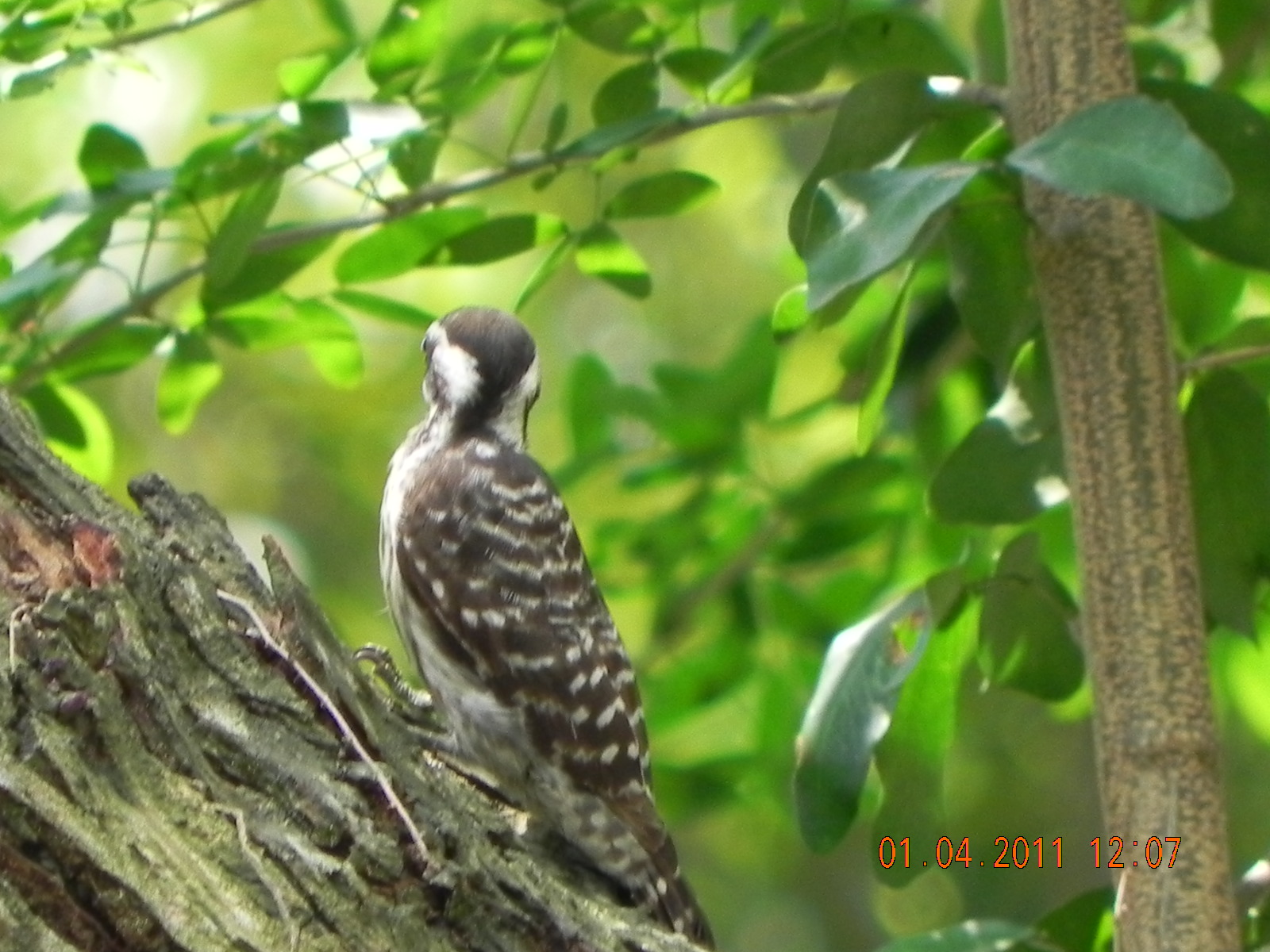
Directly above the shrubs was an interesting spider. Frankly, I know nuts about their identity but this one spun a web with a huge white cross on its web which left me wondering why it did that? On the way out, I happened to see a Sunda Pygmy Woodpecker, which I posted before, on the trunk of a huge Pithecellobium dulce (common name: Madras Thorn Tree; Family: Fabaceae / Leguminosae). How cute! In fact, I was told that this is a common bird in our urban environment and can often be seen on trees in the carpark. However, I have never seen it before until these 2 posts. Unfortunately, I wasn't able to get a good photo of it.