Last night, I was tidying up the photos taken a few days ago, with the intention to post them over these few days.
In this first photo, don't be mistaken that I am trying to showcase the Bauhinia kockiana. Instead, I am showing off the large-leaved scandent climber on the left of the Bauhinia.
It is the uncommon Red Hot Poker Vine. I took pains to choose this particular large specimen and planted it beside the fencing so that there is some support for the plant. It has been doing well thus far, and had sprouted numerous new coloured waxy leaves and strings of inflorescences since it was first planted.
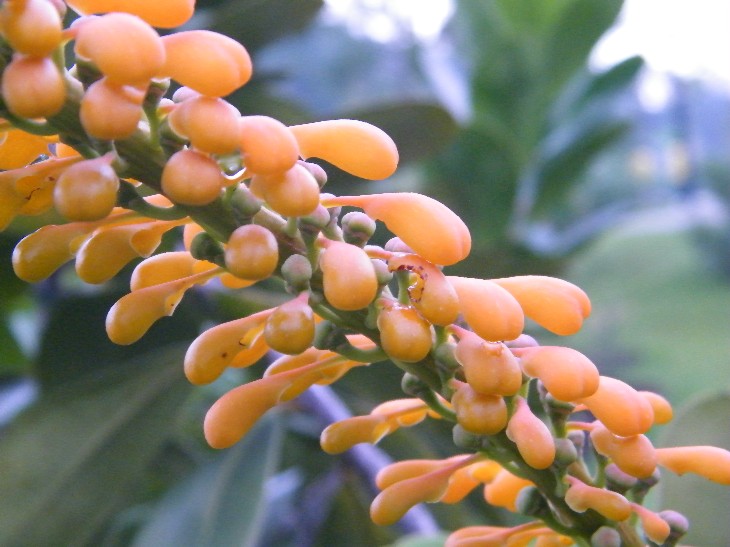
Although it is not a prolific in terms of its flowering, it is still a very reliable plant as there is always at least a sprig of the inflorescence protruding out from the plant. I managed to take photos of a developing inflorescence, as shown below. Interestingly, the red-orange structures on the inflorescence are not the flowers, but nectarines or nectar pouches that attract the birds and other insects.
Anyway, I won't be able to show the fully developed inflorescence in this particular post because the majority of branches were pruned off when I came back from my lunch today. To see the developing inflorescence, check out my earlier post.
A link is attached below for reference:
http://toptropicals.com/catalog/uid/Norantea_guianensis.htm


 It is yet another post on this interesting scandent shrub. The floral pouches have almost all turned from orange to this red colour now. Even a beetle was drawn by its nectar.


 This butterfly resting on the Norantea guianensis looks like a Dingy Bush Brown (scientific name: Mycalesis perseus cepheus) from the Nymphalidae Family.


 I am showing photos of the inflorescences of this plant again.


 Here are more photos of the Norantea guianensis. The true flowers and nectarine sacs are shown clearly in the photos.

 This is a close-up photo of the developing nectarines, with big openings, which branched out from the stalk of the smaller inconspicuous flowers.
 This is a budding Norantea, after the extensive branches were pruned off recently. Numerous buds were appearing.
 It did look a bit like amber, but it was not. These were the exudates on the cut ends of the Norantea guianensis. And they were dry to the touch.


 Last night, I was tidying up the photos taken a few days ago, with the intention to post them over these few days.


 This is one interesting plant that I took the photos on 16 Mar 10.