Showing posts with label convolvulaceae. Show all posts

02 January 2014

GREAT EGGFLY


I was pleasantly surprised to find this Hypolimnas bolina bolina (Common Name: Great Eggfly) at the Fruits and Flowers garden this morning. The host name is supposedly the Sweet Potato plant (Scientific Name: Ipomoea batatas; Family: Convolvulaceae). 

Today is a great day!


VINES

This is the first post in 2014 for me and here I am writing about climbing vines.

The first set of photos of the Scarlet Vine (Scientific Name: Mucuna bennettii) is about 3 months from the last post on the same plant in Oct 13. However, this time round, I would say the inflorescences are bigger and bolder! There are so many more clusters of the orange crescent-shaped flowers.

In the second set of photos is the Elephant Climber (Scientific Name: Argyreia nervosa; Family: Convolvulaceae) with purple flowers that remind one of the Morning Glory and large heart-shaped leaves. Although it is from the same Family, there are obvious differences such as the prominent white sepals and the white furry underside of the leaves in the former. I love the texture of the leaves and the feel of the underside is really nice, to say the least. But this climber tends to attract some pests such as mealy bugs that cause the leaves to crinkle up. It also attracts the large Carpenter Bees which thankfully don't sting people.


Purple flower with white sepals

Trumpet-shaped flowers resembling Morning Glory


White sepals left behind after corolla falls off


Furry underside of heart-shaped leaves


Fine hairs on the leaf and stems


13 November 2012

CUSCUTA

Cuscuta, which is commonly known as Dodder, is a parasitic plant from the Family Convolvulaceae. Yes, it is hard to imagine that this leafless vine-like looking plant belongs to the same family as the Morning Glory.

Like many other parasitic plants, the Dodder has haustoria that attaches itself onto the branches of its host plants and draws nutrients from it. In fact, this plant has minute scales as leaves and  an interesting life-cycle, which includes flowering and seed setting, like any other angiosperm.

I first saw this parasitic plant in the late 90s growing on and smothering a bed of dwarf Duranta shrubs I planted in front of the Lavender MRT station. I have also seen it growing on the Sphagneticola trilobata (Synonym: Wedelia trilobata, Complaya trilobata, Thelechitonia trilobata, Silphium trilobatum; Family: Asteraceae / Compositae). The only way to get rid of this parasite is not to pull it off the host plant because its remaining haustoria on the host plant is more than capable of regenerating the parasitic plant, but rather to prune the host plant back significantly to remove any remnants of the parasite. In extreme cases, the entire host plant may have to be removed and discarded and the plant replaced with a non-host species.

23 July 2012

HERITAGE GARDENS

Today's weather - sunny
These are flowers taken at the Chinese Garden. The first is the Sterculia monosperma (Common Name: Chinese Chestnut, Seven Sister's Fruit; Family: Sterculiaceae) with the beautiful cluster of pink flowers.


The second are the red flowers of the Ipomoea horsfalliae (Common Name: Cardinal Creeper, Lady Doorly's Morning Glory; Family: Convolvulaceae).


03 March 2011

TAMPINES ECO-GREEN PART 3

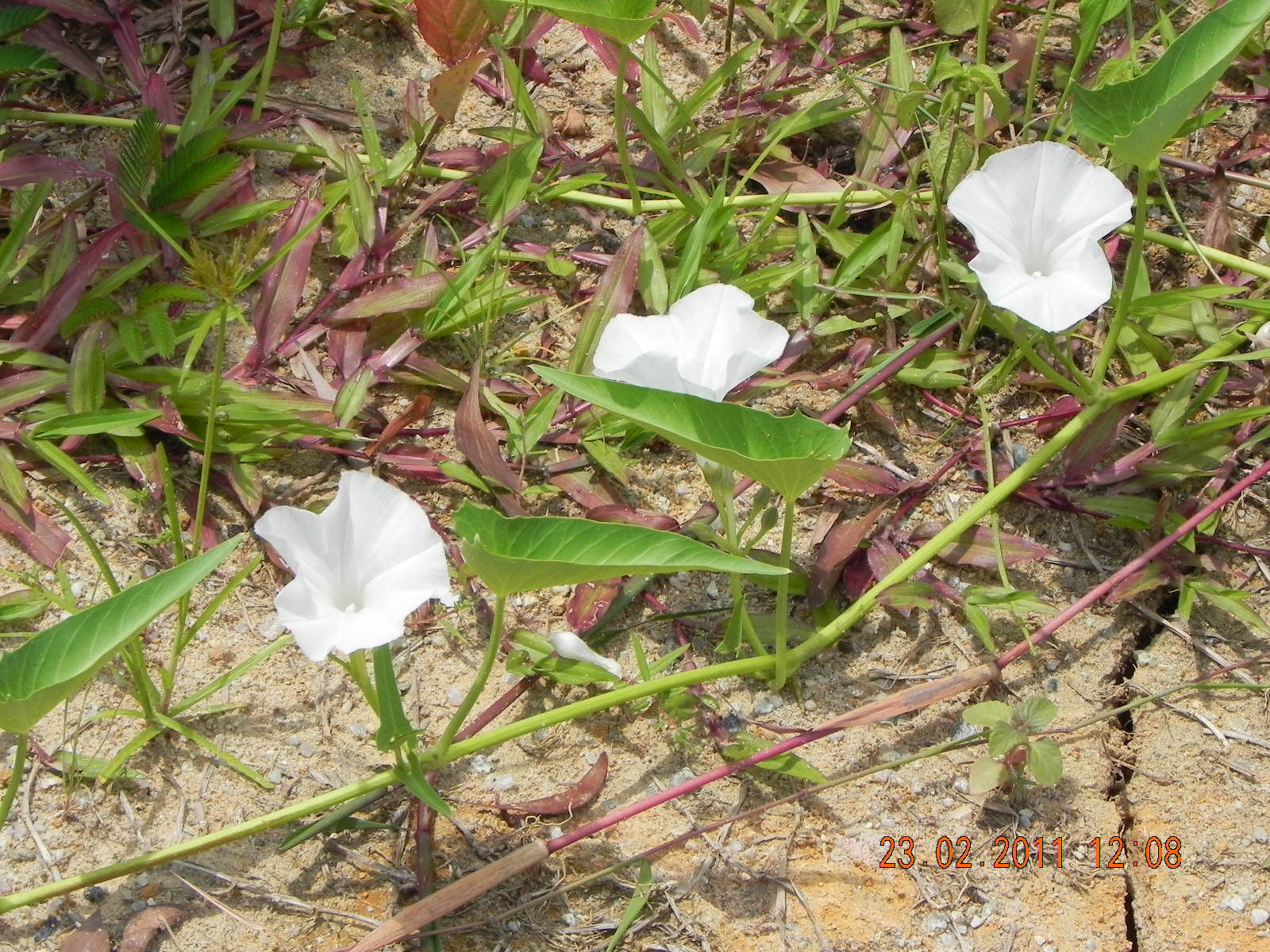
I actually like this park a lot because of the nature theme and natural environment that would support a range of fauna in its multiple habitats. There is also the white flower Kangkong (scientific name: Ipomoea aquatica; Family: Convolvulaceae), an edible vegetable, found on the ground next to a natural dried up pond.

As I ventured deeper in to the park, there were more Ludwigia, other Cyperus plants and the uncommon and native Alstonia spatulata (common name: Siamese Balsa; Family: Apocynaceae) near the water edge. Some links on the plants are shown here: