Today's weather - sunny
These beautiful landscape and plant photos were taken at HortPark recently.
The first few photos taken at the Floral Walk show the very beautiful and unusual ginger Tapeinochilos ananassae (common name: Indonesian Wax Ginger; Family: Costaceae).
The next few photos show one of my favourite tropical plants, the Megaskepasma erythrochlamys (common name: Brazilian Red Cloak; Family: Acanthaceae), that I often use in my landscape projects. I definitely feel it is under-appreciated and underused in landscaping.
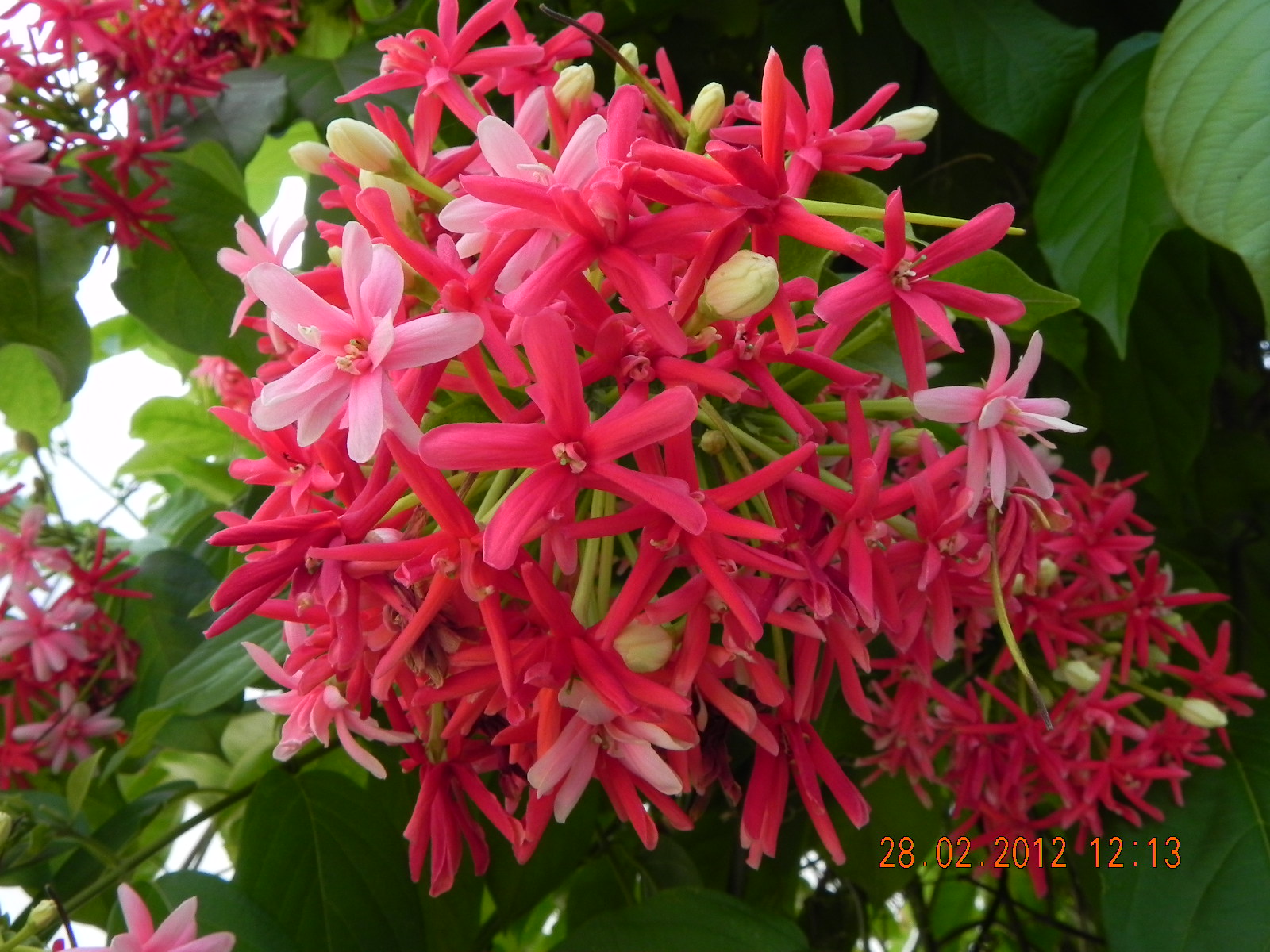
Over at the Prototype Glasshouses, the double petaled Quisqualis indica (common name: Drunken Sailor, Rangoon Creeper, Chinese Honeysuckle, Scarlet Rangoon; Family: Combretaceae) is putting out its best display to maximum effect. Who wouldn't fall in love with such an amazing climber with bunches of pendulous fragrant flowers? I don't need to be a sailor to be bewitched by it.
I also saw this unknown bird on the Ascelpias curassavica (common name: Blood Flower; Family: Apocynaceae) at the Golden Garden. Interestingly, I don't think I have seen this bird before.
Beside this garden were lots of fluttering butterflies hanging around the numerous nectar plants, such as the Leopard butterfly feeding on the nectar of the Lantana camara or Cnidoscolus chayamansa (synonym: C. aconitifolius; common name: Maya Spinach Tree; Family: Euphorbiaceae). It is certainly not surprising, considering that this is the outdoor garden of the Butterfly Garden. I also spotted the skittish Cycad Blue or Plains Cupid (scientific name: Chilades pandava; Lycaenidae) butterfly on the Antigonon leptopus (common name: Honolulu Creeper, Coral Vine, Mexican Creeper; Family: Polygonaceae).
Every time I visit this park, I am always rewarded with something pleasant that brightens up my day if I am patient enough to pay attention to my surroundings.
These Tower Trees from the Family Fabaceae / Leguminosae were flowering recently and there were quite a number of seed pods hanging from the the numerous branches high up the tree. How interesting!
This seems like a very familiar epiphyte growing in a crevice on the tree trunk and I suspect it is a Hoya although I am not entirely sure of the species. Let us see how it grows.
Today's weather - sunny
I love this monsoon canal because it supports a high diversity of aquatic plants, such as the Nymphaea sp. (common name: Water Lily), Ludwigia sp. and so on. It has to be one of the monsoon canals that is naturally vegetated.
A link on Water Lilies is shown below:
http://www.naturia.per.sg/buloh/plants/water_lily.htm
 There is this clump of Stachytarpheta indica that is actually a weed in the flowerbed at the Bay East garden entrance. However, since it was growing so well, I decided to keep it around back then.
It has rewarded the butterflies, such as this Painted Jezebel, by providing nectar to them.
Over at the pond area, I sometimes spot single marsh or shore birds, like this Common Sandpiper, strolling on the turf. Perhaps there is some food around for them to feed on.
My Hamelia patens previously suffered from a bad case of scales infestation. Recently, it was a case of severe mealy bugs infestation.
I must admit that I neglected it, like a forgotten concubine, for some time and didn't pay it much attention and didn't notice the pest infestation until it was so bad. The clusters of mealy bugs were gathered on the underside of the leaves, on the flowers and on the new leaf and floral buds etc.
It was so terrible I had no choice but to prune back the entire plant since I would much prefer not to use pesticides these days. I even shifted its orientation today and hopefully it would recover soon.
I was shown a sprig of the inflorescence recently and was amazed by its size. The white, fragrant and arrow-shaped flowers are so exotic and has a certain pure elegant beauty about it.
From the Family Rubiaceae which includes the common Ixora, this plant from Brazil has a common name Needle Flower Tree. It is known that such deep throated flowers are often pollinated by moths, or hawkmoths in this case.
It is such a delight to see and plant this rare plant in a garden worthy of its beauty. A link on this plant is attached here:
http://www.abc.net.au/local/stories/2010/11/19/3070087.htm